2013年3月20日 星期三

Yayoi Kusama’s ‘Dots Obsession'

Yayoi Kusama’s ‘Dots Obsession'


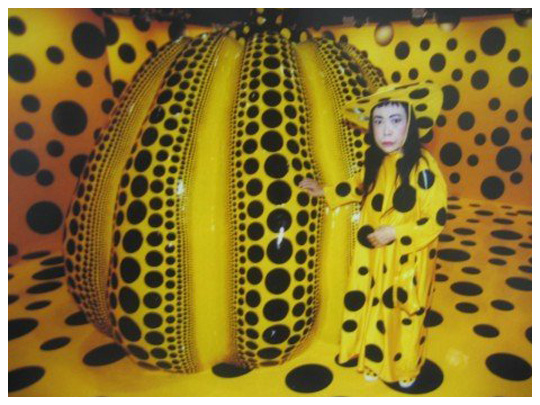
 Dotted Pumpkin 2011, reflection is presented in two modes: formally, in the continuity of the balloons’ red-and-white polka-dot pattern on the gallery walls, floor and ceiling, and in the infinite effect created by floor-to-ceiling mirrors. Both installations incorporate the viewer as a crucial element.
Dots Obsession visually approximates the hallucinations Kusama reportedly suffered as a child, in which the entirety of her surrounding space was covered with repeating patterns. The installation also reveals the artist’s careful attention to the construction of space through colour and form, and to the play of light and perspective accomplished by repeating a few simple devices — creating an immersive experience from red paint, white dots, giant balloons and strategically placed mirrors.
 Kusama’s art shows her long-term fascination with organic repetitive patterns, vigorous and psychedelic coloursreflectionelectric lights, and infinite space. Her vibrant, fascinating, magical work has an almost hallucinatory intensity.
*Fact, She lived voluntarily in psychiatric institution in order to hv a better understanding of psychology and inner visions!
The dots have therapeutic and overwhelming effect!
Offers the audiences a sense of floating and a vision of other worldiness

Julie Mehretu: Empirical Construction, Istanbul


Julie Mehretu: Empirical Construction, Istanbul, 2003


I am so happy that I have seen her latest work in Kassel:)


There are many layers of symbols and representational elements and different perspectives---bursting city!


Julie Mehretu makes large-scale, gestural paintings that are built up through layers of acrylic paint on canvas overlaid with mark-making using pencil, pen, ink and thick streams of paint. Mehretu’s work conveys a layering and compression of time, space and place and a collapse of art historical references, from the dynamism of the Italian Futurists and the geometric abstraction of Malevich to the enveloping scale of Abstract Expressionist colour field painting. In her highly worked paintings, Mehretu creates new narratives using abstracted images of cities, histories, wars and geographies with a frenetic mark making that for the artist becomes a way of signifying social agency as well suggesting an unravelling of a personal biography.
Mehretu’s points of departure are architecture and the city, particularly the accelerated, compressed and densely populated urban environments of the 21st Century. Her canvases overlay different architectural features such as columns, façades and porticoes with different geographical schema such as charts, building plans and city maps and architectural renderings, seen from different perspectives, at once aerial, cross-section and isometric. Her paintings present a tornado of visual incident where gridded cities become fluid and flattened, like many layers of urban graffiti. Mehretu has described her rich canvases as ‘story maps of no location’, seeing them as pictures into an imagined, rather than actual reality. Through its cacophony of marks, her work seems to represent the speed of the modern city depicted, conversely, with the time-aged materials of pencil and paint.

The Snail Henri Matisse

The Snail, Henri Matisse

Henri Matisse, ‘The Snail’ 1953

Happiness, Enthusiasm for life!
Balance of composition and the harmony of colours

Matisse told André Verdet (pp.64-5), 'I first of all drew the snail from nature, holding it. I became aware of an unrolling, I found an image in my mind purified of the shell, then I took the scissors'. He has combined pairs of complementary colours - red/green, orange/blue, yellow/mauve - to create a particularly vibrant effect. He gave the picture the alternative title La Composition Chromatique[Chromatic Composition].

Untitled-Robert Gober

2.Untitled-Robert Gober 1990

It reminds me of  René Magritte


In 1989, Gober began what would become a series of disembodied partial limbs with Untitled (Leg). The wax “amputation” is a cast of the artist's own leg, embedded with human hairs and dressed with a man's shoe, sock, and partial trouser. The body fragment speaks of absence, of detachment, of loss; the object is loaded with all that is not there. Gober did not place the limb on a pedestal; rather it was installed as if emerging from the gallery wall, describing an uneasy balance between interior and exterior states. Gober's disembodied limbs and appendages imply a psychological fracture. Julia Kristeva writes that in a state of abjection, borders between object and subject cannot be maintained.3 Rooted within the tradition of Freud's uncanny,Untitled Leg is difficult and unsettling because it provokes a reaction in which there is a hesitation in recognising the object as animate or inanimate.

The mundane,fragmented and displaced objects--increasing fascinating and repulsive

It is interesting to note that a simple object can generate issues e.g. isolation, mortality, victimization and vulnerability

We can always find meanings on familiar things:)

Why Your Five Year Old Could Not Have Done That: Modern Art Explained

I found this book in the public library!
I find the title of the book quite fascinating coz ppl usually said that a 5 year old kid could draw sth as Picasso.

Some modern art pieces that I find interesting and connections with the art pieces I have seen last year in the Documenta 13

1. Hannah Höch, Cut With The Kitchen Knife Through The Last Weimar Beer-Belly Cultural Epoch in Germany (1919-1920), 


CUT WITH THE KITCHEN KNIFE includes more than 150 illustrations of works Hoch created during 1918-1933, the Weimar years. Hoch assembled her montages by selecting photographs of women from illustrated print sources and juxtaposing them with fragments of scenes from Weimar and German colonial society. Readers will be intrigued by the surprising even shocking compositions which combine the pleasure of viewing mass media images with critical, even destructive feelings about the subject matter. 
It is the largest and most overtly political of Höch’s photomontages. Yet both its scale and “content” were alien to her sensibility. Most of the collages are small—“intimate” is not an inappropriate word—and without the vitriol typical of Berlin Dada. A German critic described the photomontages as being “skeptical in an almost tender way” and this seems about right. For Höch never took great interest in expounding an anti-art agenda.

I rmb:geoffrey farmer leaves of grass 2012
The work features a great number of figures cut out from the pages of Life magazine that have been mounted on dried-grass sticks.
Wt Geogreffy said: 
 I think there are many things that are going on in this piece and I hope people get a sense of that. In one of the last issues of Life, I found a small image of Susan Sontag’s book On Photography. It is about one centimetre by one centimetre. It appears at the very end of the piece, next to a tiny Lady Diana. I think, in some ways, the piece is dedicated to Sontag and to her writing. Not to say there is a warning there, but perhaps there is.

I am not really conceptual. I don’t think up a concept and then execute it. I learn through discovery and from direct contact with the material I am using. Even though the work might emanate out of an idea or interest and may have a horizon, I don’t really know exactly what I am doing

2012年10月31日 星期三

Bernard Buffet: New York


It is a city of geometric heights, a petrified desert of grids and lattices, an inferno of greenish abstraction under a flat sky, a real Metropolis from which man is absent by his very accumulation; the implicit morality of our new Greuze is that we are distinctly happier in Belleville than in Manhatten.
This is a folklore New York rather like Bizet's Spain or the Italy of the Theatre Mogador: an exoticism which confirms the Frenchman in the excellence of his habitat.

According to Buffet, the architecture of this city is uniformly longiform and quadrangular. Here the grid reigns under its most ill-favoured aspect: the contour, this black line which encloses everything, obviously intends to expel man from the city. 

By obsessively multiplying the window, by inlaying it with black, Buffet empties it, destroys it, makes the living edifice into a dead surface, as if number, unless it is swarming, must fatally establish an abstract order.

To paint New York from above, at the top, is to rely once again on the first spiritualist myth, i.e. that geometry kills man. In his way, Buffet follows in the wake of our venerable moralists, for whom the refrigerator is antipathetic to the soul. 
The intentional desolation of his New York-what can it mean except that it is bad for man to live in groups, that number kills the spirit, that too many bathrooms are harmful to the spiritual health of a nation, that a world is too 'modern' is a sinister world, that we are bored when we are comfortable, in short according to the most reactionary remark of human history, the alibi of all exploitations, that 'money doesn't make happiness?' It is not New York which is terrible, it is work. 

Roland Barthes: Buffet Finishes off New York

2012年10月15日 星期一

Dutch still life

Reading Roland Barthes: A Barthes Reader lately:)

There is an essay about Dutch still life (the title is the world as object)


Consider the Dutch still life: the object is never alone, and never privileged: it is merely there, among many others, painted between one function and another, participating in the disorder of the movements which have picked it up, put it down-in a word, utilized. There are objects whenever you look, on the tables, the walls, the floor: pots, pitchers overturned...All this is man's space: in it he measures himself and determines his humanity, starting from the memory of his gestures: his chronos is covered by functions, there is no authority in his life but one inprints upon the inert by shaping and manipulating it. 


The universe of fabrication obviously excludes terror, as it excludes style. The concern of Dutch painters is not to rid the object of its qualities in order to liberate its essence but, quite the contrary, to accumulate the secondary vibrations of appearance, for what must be incorporated into human space are layers of air, surfaces, and not forms or ideas.