2013年3月20日 星期三

La Lecture by Pablo Picasso


La Lecture by Pablo Picasso

Background story: 
It was completed by Picasso in January 1932 in time for his exhibition at the Kunsthaus in Zurich,  entitled Picasso by Picasso: His first Museum Exhibition 1932, and is a portrait of his muse, Marie-Thérèse Walter, who it is said transformed the life of this great Modernist artist. This painting was among a series from the beginning of 1932, which introduced this young woman as an extraordinary presence in Picasso’s life and his art.

The story goes that the then forty five year old artist introduced himself to the seventeen year old girl outside a Paris Metro station.  On recounting the tale of the meeting, Marie-Thérèse said she remembered Picasso’s words as they came face to face:
“…I knew nothing – either of life or of Picasso… I had gone to do some shopping at the Galeries Lafayette, and Picasso saw me leaving the Metro. He simply took me by the arm and said, ‘I am Picasso! You and I are going to do great things together’…
 La Lecture belonged to a group of paintings, painted by Picasso in January 1932 in anticipation of the major retrospective he was planning that June.  Today’s painting is Picasso’s depiction of Marie-Therese and it was the first time that she had appeared in one of his works.  Earlier paintings of his showed her features implanted discreetly in the background and it was this unconcealed portrayal of his mistress which led his wife to realise that there was another woman in her husband’s life.

Picasso’s lover and muse’s potent mix of physical attractiveness and at the same time her sexual naivety had an intoxicating effect on him and his rapturous desire for her brought about a number of compositions that are amongst the most sought after of his long career.  In 1935, Marie Thérèse Walter had a daughter with Picasso, Maria de la Concepión, called Maya.  Sadly for Maria-Thérèse, a year later in 1936, Picasso switched his affections to a new love, Dora Maar a woman he met when he was painting Guernica.  Marie-Thérèse left Picasso and took their daughter to live in Paris. 
source: http://mydailyartdisplay.wordpress.com/2011/02/02/la-lecture-by-pablo-picasso/
*wing of dove-peace and love
Heart-shaped face
Double portrait! Marie-Thérèse's face and she and Picasso are kissing

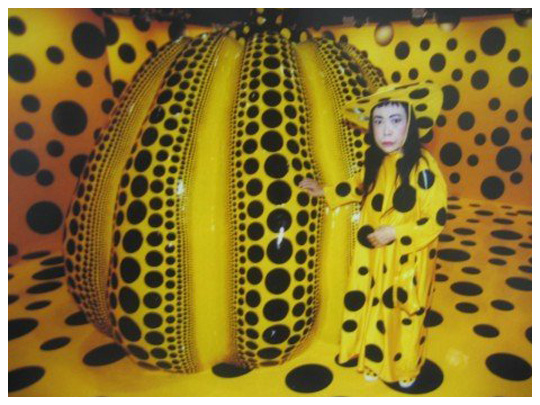
Yayoi Kusama’s ‘Dots Obsession'

Yayoi Kusama’s ‘Dots Obsession'


 Dotted Pumpkin 2011, reflection is presented in two modes: formally, in the continuity of the balloons’ red-and-white polka-dot pattern on the gallery walls, floor and ceiling, and in the infinite effect created by floor-to-ceiling mirrors. Both installations incorporate the viewer as a crucial element.
Dots Obsession visually approximates the hallucinations Kusama reportedly suffered as a child, in which the entirety of her surrounding space was covered with repeating patterns. The installation also reveals the artist’s careful attention to the construction of space through colour and form, and to the play of light and perspective accomplished by repeating a few simple devices — creating an immersive experience from red paint, white dots, giant balloons and strategically placed mirrors.
 Kusama’s art shows her long-term fascination with organic repetitive patterns, vigorous and psychedelic colours, reflection, electric lights, and infinite space. Her vibrant, fascinating, magical work has an almost hallucinatory intensity.
*Fact, She lived voluntarily in psychiatric institution in order to hv a better understanding of psychology and inner visions!
The dots have therapeutic and overwhelming effect!
Offers the audiences a sense of floating and a vision of other worldiness

Julie Mehretu: Empirical Construction, Istanbul


Julie Mehretu: Empirical Construction, Istanbul, 2003


I am so happy that I have seen her latest work in Kassel:)


There are many layers of symbols and representational elements and different perspectives---bursting city!


Julie Mehretu makes large-scale, gestural paintings that are built up through layers of acrylic paint on canvas overlaid with mark-making using pencil, pen, ink and thick streams of paint. Mehretu’s work conveys a layering and compression of time, space and place and a collapse of art historical references, from the dynamism of the Italian Futurists and the geometric abstraction of Malevich to the enveloping scale of Abstract Expressionist colour field painting. In her highly worked paintings, Mehretu creates new narratives using abstracted images of cities, histories, wars and geographies with a frenetic mark making that for the artist becomes a way of signifying social agency as well suggesting an unravelling of a personal biography.
Mehretu’s points of departure are architecture and the city, particularly the accelerated, compressed and densely populated urban environments of the 21st Century. Her canvases overlay different architectural features such as columns, façades and porticoes with different geographical schema such as charts, building plans and city maps and architectural renderings, seen from different perspectives, at once aerial, cross-section and isometric. Her paintings present a tornado of visual incident where gridded cities become fluid and flattened, like many layers of urban graffiti. Mehretu has described her rich canvases as ‘story maps of no location’, seeing them as pictures into an imagined, rather than actual reality. Through its cacophony of marks, her work seems to represent the speed of the modern city depicted, conversely, with the time-aged materials of pencil and paint.

The Snail Henri Matisse

The Snail, Henri Matisse

Henri Matisse, ‘The Snail’ 1953

Happiness, Enthusiasm for life!
Balance of composition and the harmony of colours

Matisse told André Verdet (pp.64-5), 'I first of all drew the snail from nature, holding it. I became aware of an unrolling, I found an image in my mind purified of the shell, then I took the scissors'. He has combined pairs of complementary colours - red/green, orange/blue, yellow/mauve - to create a particularly vibrant effect. He gave the picture the alternative title La Composition Chromatique[Chromatic Composition].

Untitled-Robert Gober

2.Untitled-Robert Gober 1990

It reminds me of  René Magritte


In 1989, Gober began what would become a series of disembodied partial limbs with Untitled (Leg). The wax “amputation” is a cast of the artist's own leg, embedded with human hairs and dressed with a man's shoe, sock, and partial trouser. The body fragment speaks of absence, of detachment, of loss; the object is loaded with all that is not there. Gober did not place the limb on a pedestal; rather it was installed as if emerging from the gallery wall, describing an uneasy balance between interior and exterior states. Gober's disembodied limbs and appendages imply a psychological fracture. Julia Kristeva writes that in a state of abjection, borders between object and subject cannot be maintained.3 Rooted within the tradition of Freud's uncanny,Untitled Leg is difficult and unsettling because it provokes a reaction in which there is a hesitation in recognising the object as animate or inanimate.

The mundane,fragmented and displaced objects--increasing fascinating and repulsive

It is interesting to note that a simple object can generate issues e.g. isolation, mortality, victimization and vulnerability

We can always find meanings on familiar things:)

Why Your Five Year Old Could Not Have Done That: Modern Art Explained

I found this book in the public library!
I find the title of the book quite fascinating coz ppl usually said that a 5 year old kid could draw sth as Picasso.

Some modern art pieces that I find interesting and connections with the art pieces I have seen last year in the Documenta 13

1. Hannah Höch, Cut With The Kitchen Knife Through The Last Weimar Beer-Belly Cultural Epoch in Germany (1919-1920), 


CUT WITH THE KITCHEN KNIFE includes more than 150 illustrations of works Hoch created during 1918-1933, the Weimar years. Hoch assembled her montages by selecting photographs of women from illustrated print sources and juxtaposing them with fragments of scenes from Weimar and German colonial society. Readers will be intrigued by the surprising even shocking compositions which combine the pleasure of viewing mass media images with critical, even destructive feelings about the subject matter. 
It is the largest and most overtly political of Höch’s photomontages. Yet both its scale and “content” were alien to her sensibility. Most of the collages are small—“intimate” is not an inappropriate word—and without the vitriol typical of Berlin Dada. A German critic described the photomontages as being “skeptical in an almost tender way” and this seems about right. For Höch never took great interest in expounding an anti-art agenda.

I rmb:geoffrey farmer leaves of grass 2012
The work features a great number of figures cut out from the pages of Life magazine that have been mounted on dried-grass sticks.
Wt Geogreffy said: 
 I think there are many things that are going on in this piece and I hope people get a sense of that. In one of the last issues of Life, I found a small image of Susan Sontag’s book On Photography. It is about one centimetre by one centimetre. It appears at the very end of the piece, next to a tiny Lady Diana. I think, in some ways, the piece is dedicated to Sontag and to her writing. Not to say there is a warning there, but perhaps there is.

I am not really conceptual. I don’t think up a concept and then execute it. I learn through discovery and from direct contact with the material I am using. Even though the work might emanate out of an idea or interest and may have a horizon, I don’t really know exactly what I am doing

2012年10月31日 星期三

Bernard Buffet: New York


It is a city of geometric heights, a petrified desert of grids and lattices, an inferno of greenish abstraction under a flat sky, a real Metropolis from which man is absent by his very accumulation; the implicit morality of our new Greuze is that we are distinctly happier in Belleville than in Manhatten.
This is a folklore New York rather like Bizet's Spain or the Italy of the Theatre Mogador: an exoticism which confirms the Frenchman in the excellence of his habitat.

According to Buffet, the architecture of this city is uniformly longiform and quadrangular. Here the grid reigns under its most ill-favoured aspect: the contour, this black line which encloses everything, obviously intends to expel man from the city. 

By obsessively multiplying the window, by inlaying it with black, Buffet empties it, destroys it, makes the living edifice into a dead surface, as if number, unless it is swarming, must fatally establish an abstract order.

To paint New York from above, at the top, is to rely once again on the first spiritualist myth, i.e. that geometry kills man. In his way, Buffet follows in the wake of our venerable moralists, for whom the refrigerator is antipathetic to the soul. 
The intentional desolation of his New York-what can it mean except that it is bad for man to live in groups, that number kills the spirit, that too many bathrooms are harmful to the spiritual health of a nation, that a world is too 'modern' is a sinister world, that we are bored when we are comfortable, in short according to the most reactionary remark of human history, the alibi of all exploitations, that 'money doesn't make happiness?' It is not New York which is terrible, it is work. 

Roland Barthes: Buffet Finishes off New York

2012年10月15日 星期一

Dutch still life

Reading Roland Barthes: A Barthes Reader lately:)

There is an essay about Dutch still life (the title is the world as object)


Consider the Dutch still life: the object is never alone, and never privileged: it is merely there, among many others, painted between one function and another, participating in the disorder of the movements which have picked it up, put it down-in a word, utilized. There are objects whenever you look, on the tables, the walls, the floor: pots, pitchers overturned...All this is man's space: in it he measures himself and determines his humanity, starting from the memory of his gestures: his chronos is covered by functions, there is no authority in his life but one inprints upon the inert by shaping and manipulating it. 


The universe of fabrication obviously excludes terror, as it excludes style. The concern of Dutch painters is not to rid the object of its qualities in order to liberate its essence but, quite the contrary, to accumulate the secondary vibrations of appearance, for what must be incorporated into human space are layers of air, surfaces, and not forms or ideas. 

2012年8月23日 星期四

Caixa Forum-Goya: Lights and Shadows

I have visited Barcelona in April and I have visited the Caixa Forum because it is free and there was a Goya exhibition.

He was born on 30 March 1746 and died on 16 April 1828
He was a Spanish romantic painter and printmaker regarded both as the last of the Old Masters and the first of the moderns. Goya was a court painter to the Spanish Crown, and through his works was both a commentator on and chronicler of his era.

The most famous paintings of Goya are the Nude Maja and the clothed Maja and I was so glad to view it in the Museum. 
I like the clothed Maja more than the naked Maja. Goya's master skills successfully captured the lust of in the clothed Maja. You can feel her intense seducing eyes. 


Goya became stone-deaf after a serious illness in 1792. Deafness made him more critical, mistrustful but also visually more sensitive.  He began to face the dark side of life, and at this time he created Caprichos (whims), critique of social evils and human weaknesses. 
Later, Goya witnessed the cruelty of War when French invaded Spain, completed his prints of "The Disaters of War" which was published only after his death.

2012年8月20日 星期一

Documenta: Geoffrey Farmer

Geoffrey Farmer-leaves of grass


This is one of my favourite exhibitions in the Documenta.

The work spans sixty feet and is built from thousands of clippings from US image-centric magazine-Life taken between the years of 1935 and 1985. 
Each of the small photograph cut-outs feature various objects from advertisements and articles including politicians to products evocative of a particular point in visual history for the American journal.

I think it represents our culture! It is quite nice to recognize some icons, some famous ppl, some food, toys...

Art is fun:) 


Some previous work of Geoffrey Farmer:http://www.we-find-wildness.com/2012/06/geoffrey-farmer/

2012年8月19日 星期日

Documenta 13-William Kentridge

William Kentridge: The Refusal of Time


My Spanish friend said that it is her favourite exhibition

The Refusal of Time is an installation. Five films are projected on three walls of an industrial space near the Kassel train station.  A large wooden structure with moving parts—it resembles something like an accordion and an oil rig combined—occupies the center of the room; this is the “breathing machine (elephant).” Intermittent sounds of Kentridge speaking and music (most memorably tubas and singing) are transmitted through silver megaphones, one at each corner, each with a different soundtrack. 

I was only able to watch the first 15 mins of the films because of the time limit. 
I quite enjoyed the films and the atmosphere created by Kentridge! 

Reflection: What is time? And how can one oppose its enforced standardization?
The idea of time zone and world segments!

More information: http://www.nybooks.com/blogs/nyrblog/2012/jun/30/kentridge-galison-refusal-of-time/
Video in youtube: http://www.youtube.com/watch?v=P2VPkD6MJi4

2012年8月17日 星期五

Documenta 13-Paul Chan

Paul Chan-What is what, why the why


Paul Chan-born 1973, Hong Kong, China.
Lives and works in New York, USA.


艺术家Paul Chan在dOCUMENTA 13的作品被安排在了主展区之外一栋二层矮建筑的一层,这个空间颇像一个零售店面,而这个空间安排与Paul的作品可谓相得益彰——“店面”的四壁挂满了几百本“书”,准确的说是几百张书皮。原来Paul将他的小画画在了这些书皮上,与书皮原本的颜色、结构及文字形成了新的视觉关系。用英文诠释其概念非常简单清晰:Volumes without Volume,可以尝试翻译为“没有卷的卷书”。这些书的内容Paul从来没有读过,没有了内容的书成为了承载他的视觉想象的新的平台。无论是小画还是书,都呈现着各自的不完整,而这两种不完整的组合恰恰构成了Paul在dOCUMENTA 13的相对完整的叙述。

Nice interview: http://www.artbook.com/blog-paul-chan-e-book-interview.html

Reflection: what is knowledge? What? Why?

2012年8月16日 星期四

Documenta 13-Etel Adnan

I'm happy to visit the worldly famous art exhibition, Documenta 13
Just want to record some of the nice artworks:)
First one: Etel Adnan


Etel Adnan was born in 1925 and raised in Beirut, Lebanon. Her mother was a Greek from Smyrna, her father, a high ranking Ottoman officer born in Damascus. In Lebanon, she was educated in French schools.
She studied philosophy at the Sorbonne, Paris. In January 1955 she went to the United States to pursue post-graduate studies in philosophy at U.C. Berkeley, and Harvard. From 1958 to 1972, she taught philosophy at Dominican College of San Rafael, California.

Apart from a painter, she is a author and poet!

38 untitled paintings are shown in the Documenta 13:


Etel Adnan:  "Painting is something else, a language without a language problem - an unknown, abstract world with endless possibilities. There is in it logic, a truth, a directness guided by intuition that remains elusive in words. If I want to express the spirit of a place, an emotion, an idea, I paint; if I want to describe or comment on it, I write…" 

Abstract art was the eq. of poetic expression. I didn't use the words, but colour and lines

My comment: I feel a sense of tranquility in her abstract paintings. The colours speak and express themselves:) I also can feel the joy of colour


Bokunen Naka

Just watched a programme in Japanese TV which is called Takeshi Art Beat: Bokunen Naka, woodblock print artist


The programme introduces the artist Bokunen Naka who is based on Okinawa, Japan.
His woodblock art is amazing and the programme shows how did he produce a print!

Woodblock printing is a form of fine art printmaking where an artist carves away a design from a piece of wood. In order to do this, the artist uses woodcutting tools that are somewhat similar to chisels. These tools come in a wide variety of sizes and edges such as v-shaped and u-shaped, and each individual tool produces a different cut. Printmakers well versed in their art know the exact woodcutting tool they need to produce a desired effect. 

Bokunen adds an additional dimension to his artwork by painting onto the back of the semi-translucent paper he uses for printing, enlivening the black ink images with splashes of vibrant colors. Lush, green banyan trees, cobalt oceans and carmine hibiscus pop from the pale yellow museum walls. Small placards are scattered among the museum prints that include quotes from Bokunen describing the content and inspiration for his work, as well an explanation of how he makes his art. The gallery’s far wall is a stunning series of large murals with dancer-like figures that seem to move whimsically but have enigmatic expressions. At over seven feet in height, it is easy to become lost in the scene while marveling at the time it must have taken Bokunen to create this body of work.

During the programme, he mentions about the importance of colour:)
The colours expresses themselves when they are together 
The colours have souls:) (which made me rmb the paintings of Edel Adnan which I have seen in Documenta 13)


2012年4月25日 星期三

Claude Monet's Nymphéas bleus


English name of the painting:Blue Water Lilies
(Nymphaea" is the botanical name for a water lily)


Monet focused on a small area of the pond, seen as a piece of nature, almost a close-up. No details stand out and the overall impression is one of a shapeless surface. The square format reinforces the neutrality of the composition. The lack of a frame of reference gives the fragment an infinite, limitless feeling.


I love the floating mood in this painting:) such a fantasy!
I would love to have a dream about this blue water lilies, just wonder if I could fly round them~~


P.s. There is a gigantic one in the Musée de l'Orangerie

2012年4月21日 星期六

Animals in the streets of Paris

Randomly find a nice exhibition in Paris!
Have you ever seen animals in the streets?
 "The city is a place of transit and permanent movement, a crossroads conducive to meetings. Thus, unlike the art as set out in a gallery or museum, the works presented are confronted in the street without stops passers who discover his whereabouts during daily. Sophie’s art installations lead the public to question the art and the process of contemplation in a non-formal, particularly bind and ephemeral. In addition, they raise a fundamental question with humor mental: the role of animals in our society. The presence of a Pantherre, or a giraffe at a street corner, that one has the habit of borrowing creates situations intriguing and poetic ... something to ponder ...
"
If you want to view more, please visit: http://www.sophie-photographe.com/ADLRDP%20ang.html

2012年4月17日 星期二

Gustave Caillebotte: The floor scrapers, 1876


It is quite rare that an impressionistic painting reflects the hard life of labour.
It shows the big constrast between the bourgeosis house and the working class.
We can feel the sweat and the hard work of the three men.
They are the modern day heroes.

2012年4月14日 星期六

Alfred Sisley:Boat in the Flood at Port-Marly


西 斯 勒(Alfred Sisley) 是 居 住 於 法 國 的 英 國 人 , 他 承 襲 了 英 國 風 景 畫 家 所 畫 出 的 戶 外 光 線 的 效 果 , 在 戶 外 作 畫 , 觀 察 大 自 然 時 , 捨 棄 先 入 主 之 見 , 將 感 覺 即 時 留 在 畫 面 上 , 終 於 成 為 了 印 象 派 的 大 師 。

In 1874, Sisley moved to Marly-le-Roi and became the chronicler of this village situated a few kilometres to the west of Paris. His most beautiful motif was when the Seine burst its banks and flooded the neighbouring village of Port-Marly in the spring of 1876. The artist produced six paintings of this event. He captured the great expanse of water with moving reflections that transformed the peaceful house of a wine merchant into something mysterious and poetic.

In this version, Sisley positions the house at an angle, leaving a large amount of space for sky and water. For the flooded area he used light colours and broad, brushstrokes placed side by side. Conversely, he expressed the solidity of the house and its pink and yellow walls, with very precise brushwork. Thus, the stability and permanence of the solid elements contrast with the fleeting movements of the water, which at any moment might recede.

The presence of several human figures in boats reinforces the impression of an ordinary day transformed by "a devastating invasion where the familiar, everyday, usual aspect of things was irresistibly substituted by a new, unexpected, enigmatic and disturbing expression''


What I like about this painting:
movement vs still-life
sureallity and dream-like moment
vertical house and trees
movement of the clouds

Edgar Degas: The Dance Class


Another painting by Degas! Also it is about ballet dancers.
We are in the backstage and view in eye level point
Degas recreate the life of the dancers, their realities. We can notice the different personalities of the girls, some are quite relaxed, some are still practicing.
Degas was interested in dancers because the nature of a painter and dancer is quite similar, they need to be perfect.
In the painting, our gaze is focused on the ballet master and his wood. It shows the reality of the scene, to be a successful dancer, you must devote hours and hours of practice.

2012年4月12日 星期四

Edgar Degas (1834-1917) The Orchestra at the Opera Circa


There are 2 subjects in the paintings
We are invited to observe it from the area reserved for the audience
The first subject is the ballet performance and the second one is the orchestration which is usually heard rather than seen. They are usually been ignored because they are hidden.

Degas knew the musicians personally. The composer Emmanuel Chabrier can be seen in the box and Désiré Dihau, one of Degas' friends who played at the Paris Opera, is the bassoonist. Degas juggled with the traditional arrangement of the orchestra to place him in the centre of the composition.

I really like the contrast between the two subjects and the idea of the painting:)